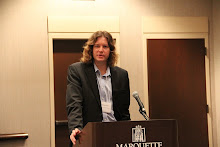
I just recently found out that my paper "What Homer can Teach us about Seynsgeschichte" was accepted for presentation at this year's meeting of the Heidegger Circle. Needless to say, I am very excited and honored.
I will also be responding to Thomas Thorp's paper "'Now that it has left its stump on the mountain;' The Withdrawal of Nature in Iliad I" at this year's meeting of the Ancient Philosophy Society.
Hope to see some of you at one or both of these events.
Showing posts with label Seynsgeschichte. Show all posts
Showing posts with label Seynsgeschichte. Show all posts
Sunday, March 6, 2011


Sunday, September 12, 2010
How should we think the History of Being?
I have been having a wonderful conversation in the comments section of my most recent post with the author of the blog Seynsgeschichte. Our conversation there had finally wandered into territory a little remote from the original blog post so I figured I would move it into a new blog post and come up with an excuse to continue the conversation and invite/encourage any other readers of this blog to join in. In his last comment Pseudonoma stated:
"As far as Seynsgeschichte itself, however, I am against all amorphous "loose" descriptions, and am equally dissatified by "narrative" accounts --which is why what you are saying, being neither one of these --is of great interest to me. For my own part I have a very particular reading of Seynsgeschichte, one which claims SG to elude all Niezschean or Foucalutian genealogy, while not simply refering to transhistorical universals, or any other for of seiendenheit."
I agree that Heidegger's conception of the history of Being is different from the histories of both Nietzsche and Foucault and also not concerned with the trans-historical. Let me say a little about the issue of Nietzsche and Foucault. I think that in Nietzsche's case, the concept of truth and a true history has been so problematized that his genealogies are to be thought primarily in strategic or (non-Heideggerian) poetic terms. They are re-descriptions which seek to shift the dominant metaphors through which we think key concepts. This isn't exhaustive of Nietzsche's history but it does make clear the sense in which history is always a history of the present, i.e. it is always a working over and working upon of current issues with the goal of bringing about future changes. In this sense history is strategic and not representational of "what actually happened" (an ontological entity whose very existence Nietzsche would call into question). I believe that Foucault's histories are similarly strategic histories of the present which refuse any belief in an "accurate" account but which general, nonetheless, follow the strategy of deriving historical change from within the micro power-structures which pre-exist the change in question. Some thinkers have claimed Heidegger must also hold such a view, i.e. that changes in the nature of the totality of practices for a life-world must derive from the practices which were in existence before the change occurred. I have called this, from time to time, the causal conception of history which understands historical events as caused by things which came before them. This seems an entirely inadequate way to conceptualize Heidegger's understanding of "ereignis", which I will generally translate as an "originary event". Heidegger's conception of history is not purely strategic, as he has not given up on the idea of truth but has rather altered the conception of it, and it is not causal insofar as originary events need not be understood as derived from what came temporally before them. I could say a lot more here but I will stop at these very brief suggestions for now.
I would like to hear more about how precisely Pseudonoma understands a "loose" description and a "narrative" account of the History of Being. I suspect I know what he means but I don't want to assume too much.
The introductory gesture having been made, then, I would like to offer two Heidegger quotations to get us on our way. Both are drawn from Heidegger's "Letter on Humanism" as it appears in Krell's Martin Heidegger Basic Writings. The first quotation is a bit of a side issue, as it glances back towards the relation of Sartre to history as well as Sartre's ability to relate to Marx, but I feel it suggests that some of what I had previously suggested about Sartre's a-historicality was also on Heidegger's mind:
"But since neither Husserl nor - so far as I have seen till now - Sartre recognizes the essential importance of the historical in Being, neither phenomenology nor existentialism enters that dimension within which a productive dialogue with Marxism first becomes possible." (p. 243)
The next quotation will be lengthy but I think it provides us with some starting material for a consideration of the History of Being:
"When philosophy attends to its essence it does not make forward strides at all. It remains where it is in order constantly to think the Same. Progression, that is, progression forward from this place, is a mistake that follows thinking as the shadow that thinking itself casts. Because Being is still unthought, Being and Time too says of it, "there is/it gives." Yet one cannot speculate about this il y a precipitately and without a foothold. This "there is/it gives" rules as the destiny of Being. Its history comes to language in the words of essential thinkers. Therefore the thinking that thinks into the truth of Being is, as thinking, historical. There is not a 'systematic' thinking and next to it an illustrative history of past opinions. Nor is there, as Hegel thought, only a systematics that can fashion the law of its thinking into the law of history and simultaneously subsume history into the system. Thought in a more primordial way, there is the history of Being to which thinking belongs as recollection of this history, propriated by it. Such recollective thought differs essentially from the subsequent presentation of history in the sense of an evanescent past. History does not take place primarily as a happening. And its happening is not evanescence. The happening of history occurs essentially as the destiny of the truth of Being and from it. Being comes to destiny in that It, Being, gives itself. But thought in terms of such destiny this says: its gives itself and refuses itself simultaneously. Nonetheless, Hegel's definition of history as the development of 'Spirit' is not untrue. Neither is it partly correct and partly false. It is as true as metaphysics, which through Hegel first brings to language its essence - thought in terms of the absolute - in the system. Absolute metaphysics, with its Marxian and Nietzschean inversions, belongs to the history of the truth of Being. Whatever stems from it cannot be countered or even cast aside by refutations. It can only be taken up in such a way that its truth is more primordially sheltered in Being itself and removed from the domain of mere human opinion. All refutation in the field of essential thinking is foolish. Strife among thinkers is the 'lovers' quarrel' concerning the matter itself. It assists them mutually toward a simple belonging to the Same, from which they find what is fitting for them in the destiny of Being." (p. 238-239)
Subscribe to:
Posts (Atom)