Showing posts with label Definitions of philosophy. Show all posts

Sunday, June 13, 2010

Eugene Delacroix and the Unthinkable


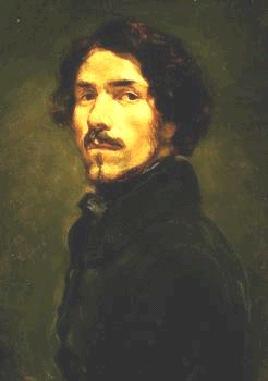
One of my favorite painters is Eugene Delacroix. I have a small volume of selections from his journals which I enjoy randomly picking up from time to time in order to read a few days of entries. I was doing so this morning over breakfast and came up a moment of reflection about the unthinkable. This is Delacroix at the age of 26, from Lucy Norton's translation of his journal:

"...I should like to write a kind of memorandum on painting, in which I could discuss the differences between the arts. How in music, for example, form predominates over matter. In painting it is just the reverse... This art, like music, is higher than thought; hence it has the advantage over literature, through its vagueness."


He also has a word or two to say about philosophers. This is following the death of Gericault which hit him very hard:

"Ignorant middle-class people are very lucky. Everything in nature seems simple to them; things are as they are, and that is explanation enough. And really, are not they more reasonable than the dreamers who go so far that they begin to mistrust their own minds? A friend dies. Because they believe that they understand the meaning of death, they do not add to the sorrow of mourning him the cruel anxiety of being unable to explain so natural an event. He was alive, he is alive no longer; he talked with me, we understood each other; nothing of all this remains, except this tomb. Is he lying in this cold grave, as cold as death itself? Will his spirit hover about his gravestone? And when I think of him, is it his spirit that stirs my memory? Familiarity with an idea reduces us all to the level of the common herd. After the first shock we realize 'he is dead' and the idea no longer disturbs us. Wise men and philosophers seem to be far less advanced in this than the ignorant, since the very thing that should serve them as proof is not even proved for them. I am a man. What is this I? What is this thing a man? They spend half a lifetime in verifying, and pulling to pieces bit by bit, something that has already been discovered. During the other half, they lay the foundations of an edifice that never rises above the level of the ground."

I find this to be such a striking passage for many reasons. Not the least of these reasons is the sense that, despite his admiration for the common herd which finds itself no longer troubled by death simply through familiarity, Delacroix himself fails as much as the philosopher to simply accept death or man. You can feel him here both asking and wishing to escape the questions he points to in others. I also rather admire his implicit definition of philosophy. Perhaps philosophy is precisely this, the refusal to grow accustomed to the things which once disturbed us, the refusal to allow familiarity to stand in for understanding or an answer.

Saturday, April 17, 2010

"Teaching Philosophy of Art to Artists" or "The Issue of Influence"

I have had the pleasure of teaching an aesthetics course to students at a college of art and design for the last two years. I am also just finishing up teaching an "Ethics in the Arts" course this semester. The first course consists, generally, of artists and designers while the second has been made up of mostly non-artists.

I find that teaching artists poses fairly unique challenges. On the one hand they tend to be very passionate and committed to what they do, which is not necessarily true of standard college students. This presents a wonderful opportunity. If you can somehow connect to their passion, and channel that interest towards the topics and authors you are teaching, you can end up with an exceptionally engaged group of students.

On the other hand artist tend to be focused on what they make to the exclusion of other interests. For example, often I find that they originally don't have much interest in questions about the larger meaning or history of what they produce. They make what they make, they like what they like, and at first this seems to them to be perfectly sufficient. In this situation, when you introduce them to the history of the philosophy of art, the fairly common response tends towards defensiveness and resentment. Who are these random intellectuals and philosophers, the students wonder, to tell artist what they should or shouldn't make or how their work is to be judged? This is, in my opinion, an absolutely justifiable attitude.

We can convince artist to care about philosophy of art in several fairly obvious ways. Clearly, if they hope to be professional artist or designers, their success is going to depend on the critical responses of others and these responses are going to be informed by theory drawn, in most cases, from a fairly standard collection of starting philosophical positions. Also, the history of thought concerning art can provide artists with the inspiration to develop in new and unexpected directions. Warhol, for example, would never have even thought of many of his works without the grounding in the history and philosophy of art which influenced his activities. What he was providing, in many ways, was a commentary and response to the history of thought about art.

Probably the most interesting and important reason for artists to study philosophy of art, however, has to do with their relation to their influences. We are, whether we know it or not, influenced by the traditions and practices in which we find ourselves. These influences can be passively accepted by us with little or no knowledge on our parts of their origin and meaning. On the other hand, these influences can be made conspicuous to us through a study of the history of thought. Once these influences are clear to us we can take a more active stance in response to them, playing some of them off against others or seeking new influences through which to weaken or change previous ones. The key is recognizing that influence is inevitable and inescapable. The choice we are left with is whether we will be passive and ignorant in the face of influence or active and aware.

I draw here on the literary critic Harold Bloom's discussion of influence and strong misreadings which Richard Rorty has also put to work. Bloom suggests that fear of influence is one of the most basic forces that work upon the creative activity of artists in general, although he tends to focus upon the literary realm that is his main domain of interest. As influence is actually inescapable, the main strategy to free oneself from influence which Bloom discovers in the history of literature is the use of the strong misreading. In a strong misreading we take our influences and actively gain some control over, and thus freedom from, them through creatively rereading or insightfully rediscovering them. What we see here is something rather similar to the concept of redeeming the past we find in Nietzsche. The past is redeemed by giving it new meaning in relation to contemporary purposes and concerns. In this sense, to borrow from Foucault, every history becomes a history of the present, an effective history aimed at changing the present and future through a re-evaluation of the past.

The web of influences can be played with but never destroyed, rereading or misreading will itself be an influenced endeavor. It is, as I formulated it earlier, a case of actively playing influences one against the other. To do so, however, requires an ever deepening understanding of the history and vicissitudes of the practices, traditions and philosophies in which we find ourselves.

I believe this to be the most valuable contribution that the study of philosophy of art offers artists themselves. It should be clear, however, that we all find ourselves in this relation to influence. In general, then, this is also one of the strongest justifications for the study of philosophy generally. An active and clear-sighted relation to influence is surely a prerequisite for freedom and rationality, however we may conceive of these.

Wednesday, April 14, 2010

Philosophy and Systematicity

"The principle that philosophy should be this sum of knowledge treated not simply as a juxtaposition of facts in the memory but as a synthesizing operation is still retained, but with great difficulty; every day philosophy becomes a little more of a specialized discipline like the others... philosophy is the sum of the possibles in the sense of a synthesis, or nothing." Georges Bataille

It will probably come as no surprise that, despite what Bataille suggests here, I find it insufficient to think of philosophy as necessarily aiming at a synthetic unity of human knowledge or any total system. Such a conception of philosophy would leave out those anti-systematic thinkers I find to be so important to philosophy's history, such as Nietzsche.

I had an extended conversation with one of my Existentialism students after class a few weeks ago. She was expressing surprise that, despite the difficulties of both authors, once she understood what Heidegger was saying she found his view to be very intuitive while Sartre struck her as foreign and unusual. She couldn't see where his view on pre-reflective consciousness and radical freedom was coming from. Once I got past my surprise, I have found most students find the idea of radical freedom fairly intuitive at first, we engaged in an interesting discussion about some general differences between the the German and French philosophical traditions.

In a general way, I suggested, German philosophy is more fixated upon systematicity and orientation in relation to a whole or totality. I had in mind both the architectonic of Kant and the system of Hegel which have their clear influence on the work of Neo-Kantians, Phenomenologists and Logical Positivists alike, to say nothing of Marxists. French philosophy, on the other hand, tends to prioritize subjectivity rather than totality. Here I suggested the deep debt that most French philosophy, often against its own will, owes to Descartes and the cogito. This influence is very clear in Sartre.

It strikes me now, in recalling this conversation, that philosophy since the birth of modernity has generally had two well-springs. These are Descartes and Spinoza. Generally speaking we find here the choice of prioritizing individual subjectivity and attempting to build towards a totality from there or, alternatively, prioritizing a whole within which alone we are to find subjectivity as a moment.

This conception is not, however, sufficient to derive the contrast between systematic and anti-systematic philosophy. Although radical subjectivity may end up serving well in anti-systematic philosophy, for example in Kierkegaard and Bataille himself, it does not itself necessitate anti-systematicity. Descartes himself had a commitment to his own architectonic and the dream of philosophy as a synthesis of all knowledge or a mathesis universalis fits well within Descartes project. It seems that to find the real origin of anti-systematicity in philosophy we need to go back to the beginning, to Plato.

Although this might be scandalous in some circles, I would suggest that Plato's presentation of the philosophical project and life prioritizes context and the concerns of the moment over any totalizing theory of, for example, the Good or human virtue. Such large scale theories arise, but they arise as hypotheses applied to specific problems. Further, the very form that such theories take throughout the course of the dialogues shift and change, often in essential details. These shifts are not, I would suggest, necessarily the working out and development of what the creators hope to eventually be a finished system but rather are adjustments made in the face of changing context and concerns. If anything this is what the dialogue form teaches us, that philosophy always arises from and answers to the historically and culturally contextualized concerns of the moment. Perhaps it is not until Aristotle, if even then, that we find a real attempt at the creation of an a-historical synthesis of knowledge. Nietzsche always had a tortured relationship to Socrates and Plato but it may be from them that he derives his anti-systematicity.

Sunday, April 11, 2010

The Indiscernibility of Philosophy Ahead of Time

During a job interview I was asked to define the term "philosophy". My answer was fairly lame and uninteresting. Something to the effect that philosophy is a practice of critically reflecting upon thought. Aside from being uninteresting there are also reasons why I don't necessarily agree with this definition. To begin with I am not convinced that philosophy only reflects upon thought nor that it need always be critical.

I wrote a paper once discussing the question of whether or not a uniquely African form of philosophy exists. My paper ended up focusing on debates in the African context surrounding attempts to define philosophy. I argued for a position rather like Paul Feyerabend's principles of proliferation and tenacity and suggested that developing any definition of philosophy which would foreclose from the start any method of inquiry, style of writing, or subject of interest leads to an unnecessary loss of productivity and creativity in the field.

One concern we might have with this view is born from the idea that standards are necessary in any discipline and that these standards should be worked into the definition and self-conception of the discipline itself. By setting firm boundaries on what counts as philosophy we guard against the production of poor work.

It seems to me, however, that any principle broad enough to figure in a definition of philosophy is likely to fail in any number of concrete cases. Can't we rightly question the value of work once it has been done, rather than attempting to determine the outcome ahead of time?