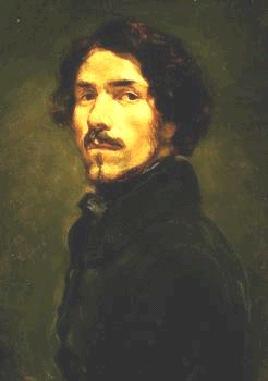
One of my favorite painters is Eugene Delacroix. I have a small volume of selections from his journals which I enjoy randomly picking up from time to time in order to read a few days of entries. I was doing so this morning over breakfast and came up a moment of reflection about the unthinkable. This is Delacroix at the age of 26, from Lucy Norton's translation of his journal:
"...I should like to write a kind of memorandum on painting, in which I could discuss the differences between the arts. How in music, for example, form predominates over matter. In painting it is just the reverse... This art, like music, is higher than thought; hence it has the advantage over literature, through its vagueness."

He also has a word or two to say about philosophers. This is following the death of Gericault which hit him very hard:
"Ignorant middle-class people are very lucky. Everything in nature seems simple to them; things are as they are, and that is explanation enough. And really, are not they more reasonable than the dreamers who go so far that they begin to mistrust their own minds? A friend dies. Because they believe that they understand the meaning of death, they do not add to the sorrow of mourning him the cruel anxiety of being unable to explain so natural an event. He was alive, he is alive no longer; he talked with me, we understood each other; nothing of all this remains, except this tomb. Is he lying in this cold grave, as cold as death itself? Will his spirit hover about his gravestone? And when I think of him, is it his spirit that stirs my memory? Familiarity with an idea reduces us all to the level of the common herd. After the first shock we realize 'he is dead' and the idea no longer disturbs us. Wise men and philosophers seem to be far less advanced in this than the ignorant, since the very thing that should serve them as proof is not even proved for them. I am a man. What is this I? What is this thing a man? They spend half a lifetime in verifying, and pulling to pieces bit by bit, something that has already been discovered. During the other half, they lay the foundations of an edifice that never rises above the level of the ground."
I find this to be such a striking passage for many reasons. Not the least of these reasons is the sense that, despite his admiration for the common herd which finds itself no longer troubled by death simply through familiarity, Delacroix himself fails as much as the philosopher to simply accept death or man. You can feel him here both asking and wishing to escape the questions he points to in others. I also rather admire his implicit definition of philosophy. Perhaps philosophy is precisely this, the refusal to grow accustomed to the things which once disturbed us, the refusal to allow familiarity to stand in for understanding or an answer.