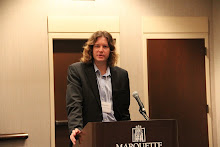
The first volume of the journal Speculations, dedicated to Speculative Realism, is now available. It can be purchased or downloaded for free here, you should check it out. As noted within the volume, not only is it the first journal dedicated to Speculative Realism it is also the first volume of a journal in which every contributor is a philosophy blogger on top of their academic credentials. It is a very interesting project. It's editor is Paul Ennis whose blog is worth checking out.
While perusing the volume I think I was most struck by Fabio Gironi's "Science-Laden Theory: Outlines of an Unsettled Alliance" which focuses on clarifying the origins and nature of the mixed bag which has come to be known as Speculative Realism as well as on investigating the movement's complex relationship to science. In connection with my previous blog post, it is the issue of the conception of science we find in thinkers like Meillassoux which most attracted my attention to Gironi's paper. The general idea is that, while continental philosophy became more and more correlationist, anti-realist and/or social constructivist in the previous century, science was left to be Reality's one remaining champion. As Gironi puts it:
"A reality in-itself which, having been banned by transcendental idealism and phenomenology first, became the open target of postmodernism and social constructivism later. This historical dismissal allowed science to claim privilege on ‘reality’; and yet, what for science was a reason for pride, to ‘postmodern’ eyes was a weak spot, so that science could be identified as the naïve—and yet powerful—cousin to be debunked. This is the attitude against which speculative realism is an internal philosophical reaction."
As my previous blog post should suggest, I think it is highly unlikely that "science" in general is a realist phenomenon or that scientists in general are realists. Einstein tends towards realism, for example, while Neils Bohr tended towards instrumentalism. I take the lesson taught to philosophers such as Duhem, Bachelard, Koyre, Kuhn and Feyerabend by the history of science very seriously, namely that there have been many very differently formulated sciences but nothing that could count as the basic characteristics of Science. This is the case both when we attempt to generalize over extended periods of history and when we generalize over the various individual disciplines out of which science is formed. I am tempted to suggest that when speaking of science we are, at best, dealing with a family resemblance. Certainly throughout history, and in the philosophy of science, realism is far from occupying a position of unquestioned dominance.
But the issue isn't about philosophy of science, and for now we might put the history of science aside. Instead let us look at the words of two fairly well respected scientists on the subject.
First we can look at Richard Feynman. In his paper "What is Science?", following an apology for even giving the talk considering his dislike for "philosophical exposition", he states that science is "the result of the discovery that it is worthwhile rechecking by new direct experience, and not necessarily trusting the race experience from the past." In other words, science is defined for him primarily as a method for evaluating traditionally received wisdom and, through observation, developing new wisdom. In "The Uncertainty of Science" Feynman claims that science is a method of finding things out in which "observation is the ultimate and final judge of the truth of an idea." It is important to observe that Feynman's commitment to the idea of science as primarily a method of discovery and critique prioritizing skepticism and observation is perfectly constructed to deflate the idea that science is based on something like the realist belief in a subject-independent and stable reality. Paul Feyerabend is, at times, just as committed to the idea of prioritizing observation and experience as is Feynman but he believes he can conjoin this priority with his various brands of anti-realism and relativism.
If we really pay attention to Feynman's view we can suggest two possible conclusions. Either the question of realism is an empirical question which observation must be allowed to investigate, in which case it seems pretty clear that no falsification of the various anti-realist positions has yet been produced, or realism is not something which observation can support or falsified, in which case it lacks any scientific status whatsoever. It is interesting to note that Thomas Kuhn DID think that the empirical data which makes up the history of science, for example the structure of paradigm change, suggested conclusions about ontology. Paul Feyerabend, extending and radicalizing Kuhn, thought that those conclusions supported relativism and anti-realism. Certainly both the data and the conclusions of these thinkers have been challenged but their existence should, at the very least, make us hesitate before we speak of science as unquestionably either essentially realist or as having produced discoveries exclusively supporting realism.
The suggestion that realism is a metaphysical position outside the boundaries of scientific inquiry is made, I feel, by Stephen Hawking when he embraces without reserve what he takes to be Popperian positivism. In The Universe in a Nutshell he states:
"Any sound scientific theory, whether of time or of any other concept, should in my opinion be based on the most workable philosophy of science: the positivist approach put forward by Karl Popper and others. According to this way of thinking, a scientific theory is a mathematical model that describes and codifies the observations we make. A good theory will describe a large range of phenomena on the basis of a few simple postulates and will make definite predictions that can be tested. If the predictions agree with the observations, the theory survives that test, though it can never be proved to be correct. On the other hand, if the observations disagree with the predictions, one has to discard or modify the theory. (At least, that is what is supposed to happen. In practice, people often question the accuracy of the observations and the reliability and moral character of those making the observations.) If one takes the positivist position, as I do, one cannot say what time actually is. All one can do is describe what has been found to be a very good mathematical model for time and say what predictions it makes."
Let us say one is concerned with the question of reality as it applies to time. One goes to a physicist such as Dr. Hawking and asks "Is the nature of time stable and independent of human subjectivity?" The answer is likely to be something like the following: "I am not sure what sort of observational consequences either the realist or anti-realist hypotheses will have, and so I can't imagine a test of either hypothesis." But the question is clearly a meaningful and powerful question about the ontology of time. The scientist, as presented by Hawking, is not necessarily attempting to say what time actually (ontologically) is but rather avoids metaphysical claims in preference for claims based on predictive and observational content. One could be a realist, an anti-realist, or an agnostic on the issue and still do science just the way Hawking does. Of course many scientists do speculate beyond the boundaries of their strictly scientific work but their views are varied and not, strictly speaking, the views of "science". It is worth noting, for an example from philosophy of science rather than science proper, that Popper himself was a realist while many have wondered whether his actual philosophy does not rather lead to instrumentalism. At the very least we can say that his realism was methodological, taking the form of a regulative ideal, and seemingly unfalsifiable and thus unscientific by his own standards.
Let me end, then, by stating my concern in a very flatfooted manner. Speculative Realism seems very interested in defining itself as a philosophy, or collection of philosophies, with a specific relationship to science. I worry, however, that it may have too narrow a view of what science is and does. One wonders, for example, what the Speculative Realist champion of Realist Science would say to an instrumentalist or conventionalist scientist?
Showing posts with label Meillassoux. Show all posts
Showing posts with label Meillassoux. Show all posts
Monday, August 16, 2010


Sunday, August 15, 2010
Berkeley and Meillassoux on what Science Says
While rereading Berkeley's A Treatise Concerning the Principles of Human Knowledge for some work on nominalism I am doing I stumbled upon an interesting moment. In section 58 Berkeley considers an objection to his proposal that things exist as ideas without existing as material objects potentially independent of any mind whatsoever. Specifically, the objector states that science has shown that the earth moves, but as no one can directly observe the movement of the earth science has asserted, and seemingly proven, a claim about something which no mind experiences. Berkeley responds by stating that what the well supported scientific theory should be understood to be about is what would be observed were one to place oneself in a given position in the future in relation to the earth. In other words, the content of the scientific theory is a prediction about future observations and applications based on past observations. Here is the text:
"58. Tenthly, it will be objected that the notions we advance are inconsistent with several sound truths in philosophy and mathematics. For example, the motion of the earth is now universally admitted by astronomers as a truth grounded on the clearest and most convincing reasons. But, on the foregoing principles, there can be no such thing. For, motion being only an idea, it follows that if it be not perceived it exists not; but the motion of the earth is not perceived by sense. I answer, that tenet, if rightly understood, will be found to agree with the principles we have premised; for, the question whether the earth moves or no amounts in reality to no more than this, to wit, whether we have reason to conclude, from what has been observed by astronomers, that if we were placed in such and such circumstances, and such or such a position and distance both from the earth and sun, we should perceive the former to move among the choir of the planets, and appearing in all respects like one of them; and this, by the established rules of nature which we have no reason to mistrust, is reasonably collected from the phenomena."
On reading this I was struck by a surface resemblance to the problem of the arch-fossil in Meillassoux's After Finitude. There Meillassoux claims that some science presents us with "ancestral statements" and the discovery of "arch-fossils". The first of these is understood as a statement about how things were before the development of thought in the universe. Imagine, for example, a hypothesis about the first few minutes following the Big Bang. The second of these are evidences which support ancestral statements. Consider, for example, light reaching the earth from a portion of space over thirteen billion light years away. Such light would be just now reaching us from a time comparably close to the time of the Big Bang and thus almost certainly from a time before the development of any consciousness or thought. Ancestral statements, then, speak of a universe without, and before, consciousness or thought and arch-fossils are evidences of such times. This point is central for Meillassoux for several reasons, not the least of which is that it allows him to claim that the completely honest correlationist must admit to rejecting science. (By a "correlationist", as I have discussed in other posts, Meillassoux means someone who claims that being and thought or being and consciousness are necessarily connect such that it ultimately makes no sense to speak of the one without the other. To be is to be given to consciousness.)
Of course Meillassoux stresses in his book that the problem of ancestral statements is not the same as the problem of the unobservered, i.e. the old problem of whether an event occurs if there is no one there to witness it. He wants to stress that ancestral statements and arch-fossils are not about things which just happen not to have been witness but are rather about things which based upon their very temporal nature could not have been witnessed. Their temporal being necessitates unobservability by consciousness. This being the case, Berkeley's example is not precisely the same. However, his answer is certainly the answer that many a correlationist is likely to jump to and one which Meillassoux, who so often takes Berkeley as a model for the most extreme of his enemies, is familiar with. What is odd, however, is that Berkeley's answer presents a plausible and coherent understanding of what the scientist is actually up to. Even today any number of scientists seem unlikely to object to his description. Meillassoux insists, however, that scientists mean their ancestral statements literally and it is only the sophistic correlationist philosopher who feels the need to hedge the meaning of their statements. Meillassoux states:
"Thus, a philosopher will generally begin with an assurance to the effect that his theories in no way interfere with the work of the scientist, and that the manner in which the latter understands her own research is perfectly legitimate. But he will immediately add (or say to himself): legitimate, as far as it goes. What he means is that although it is normal, and even natural, for the scientist to adopt a spontaneously realist attitude, which she shares with the ‘ordinary man’, the philosopher possesses a specific type of knowledge which imposes a correction upon science’s ancestral statements– a correction which seems to be minimal, but which suffices to introduce us to another dimension of thought in its relation to being."
The question, then, is what a scientific hypothesis actually means or, to put it differently, whether science is even able to formulate ancestral statements when we avoid short cuts or common language translations in our formulations of what a hypothesis or theory states?
Let me first state that it seems that we can find non-temporal arch-fossils and ancestral statements that allow us to clarify the problem by glancing at some of the major developments in twentieth century physics. Subatomic particles are, in their very being, un-able to be directly observed by anything like consciousness. They are small enough objects or events that it seems fairly safe to assert that their very being forecloses all unmediated observation. Statements about subatomic particles are, then, ancestral statements about a region of being, admittedly spacial and not temporal, which by its very nature is independent of any correlation with consciousness or thought. How, then, do scientists understand their hypothesis about subatomic particles? Do they always and simply intend them "literally" and in a naive realist sense? This seems pretty clearly not to be the case. Models of, for example, the structure of the atom are taken to be precisely that, models, partaking more of the nature of metaphor than of factual claims. The models attempt to capture in intuitive forms, as far as possible, the predictive and observational consequences of various theories while suffering from the various drawbacks associated with metaphors, i.e. they work in certain regards but not in others. Look at the debates between Bohr, Heisenberg and Schrodinger concerning wave/particle duality or the uncertainty principle and you will see clashes over how much of the metaphors are useful and how much not. For example, does the uncertainty principle say something literal about subatomic particles, i.e. that they REALLY EXIST as something like waves of probability until they are observed and collapse into a given determined form, or does it say something about the limits of our observational capabilities and the inadequacy of our concepts (metaphors?) "wave" and "particle"? These are old problems and the general way out of them is to state that the meaning of the theories in question is their observational and predictive consequences and not the common-language stories about what the subatomic world is like which we attempt to spin out of them. One focuses on the differences which make a difference in scientific practice.
When I was an undergraduate student at Boston University I studied some physics with Dr. Lawrence Sulak, the discoverer of the finite mass of the neutrino. I was reading a book on super-string theory and asked professor Sulak what he thought about the theory. His response was that it was a beautiful fairy tale. His reasoning was that, at the time, super string theory had no observational or predictive consequences and so didn't exist as an actual scientific theory at all. Clearly here there are also echoes of Popper's proposal that a theory which can never be falsified, because it has no predictive consequences, is not science. One could envision using Popper's guidance to distinguish between the scientific and non-scientific content of a hypothesis which would be a practice of distinguishing between the observational-predictive content of a hypothesis and whatever else they may contain, such as the metaphorical content used to make a hypothesis more imaginable for both the theoretician and common public.
In theoretical physics it is not uncommon to find a very sharp and powerful distinction drawn between the real hypotheses, which tend to consist of mathematical formulations and observational predictions, and the every day common language translations of these hypotheses. To put this in more pragmatic terms, and to connect it with Berkeley's original claim, the hypothesis is about what one can observe now or in the future and what one can do with the hypothesis. This is, arguably, the scientific content of the hypothesis from the standpoint of at least some, and I suspect many, physicists. This point has become more and more important in physics because the hypotheses with which the physicist works have been getting harder and harder to capture in everyday descriptive language.
Astrophysics, because it works at a macro rather than micro level, tends to be more friendly to common language formulations and descriptions. Nonetheless it often enough finds itself forced to admit that the actual content of its theories are mathematical formulations conjoined with observational predictive content and not common language descriptions. Cases of talking about "the warpage of space-time by mass" are a fair example here. At best what we are dealing with in this case are mostly failed metaphors, failed because impossible to imagine even though formulated in everyday descriptive language, for a mathematical formulation of observational predictions. This, then, will be equally true of hypotheses which are taken to be about the universe before the development of consciousness. The scientific content of such hypothesis is conceivably held by some scientists to strictly be their observational predictions and applications, not their everyday descriptive formulation into a story about the early moments of the universe. For an ancestral statement, then, it is precisely not the ancestral part of the statement which seems to be its scientific content. For this reason we might even say that science conceived in this manner is unable to formulate ancestral statements.
I tend to side with Feyerabend on these issues to the effect that there is little to nothing that can be said about Science in general. However it seems to me that we have good reason to think that Berkeley's understanding of scientific practice may be less violent to it than Meillassoux's and, in fact, that Meillassoux may himself be caught in the position of having to admit that he is playing the role of the sneaky philosopher making scientific statements say something other than they actually tend to say.
"58. Tenthly, it will be objected that the notions we advance are inconsistent with several sound truths in philosophy and mathematics. For example, the motion of the earth is now universally admitted by astronomers as a truth grounded on the clearest and most convincing reasons. But, on the foregoing principles, there can be no such thing. For, motion being only an idea, it follows that if it be not perceived it exists not; but the motion of the earth is not perceived by sense. I answer, that tenet, if rightly understood, will be found to agree with the principles we have premised; for, the question whether the earth moves or no amounts in reality to no more than this, to wit, whether we have reason to conclude, from what has been observed by astronomers, that if we were placed in such and such circumstances, and such or such a position and distance both from the earth and sun, we should perceive the former to move among the choir of the planets, and appearing in all respects like one of them; and this, by the established rules of nature which we have no reason to mistrust, is reasonably collected from the phenomena."
On reading this I was struck by a surface resemblance to the problem of the arch-fossil in Meillassoux's After Finitude. There Meillassoux claims that some science presents us with "ancestral statements" and the discovery of "arch-fossils". The first of these is understood as a statement about how things were before the development of thought in the universe. Imagine, for example, a hypothesis about the first few minutes following the Big Bang. The second of these are evidences which support ancestral statements. Consider, for example, light reaching the earth from a portion of space over thirteen billion light years away. Such light would be just now reaching us from a time comparably close to the time of the Big Bang and thus almost certainly from a time before the development of any consciousness or thought. Ancestral statements, then, speak of a universe without, and before, consciousness or thought and arch-fossils are evidences of such times. This point is central for Meillassoux for several reasons, not the least of which is that it allows him to claim that the completely honest correlationist must admit to rejecting science. (By a "correlationist", as I have discussed in other posts, Meillassoux means someone who claims that being and thought or being and consciousness are necessarily connect such that it ultimately makes no sense to speak of the one without the other. To be is to be given to consciousness.)
Of course Meillassoux stresses in his book that the problem of ancestral statements is not the same as the problem of the unobservered, i.e. the old problem of whether an event occurs if there is no one there to witness it. He wants to stress that ancestral statements and arch-fossils are not about things which just happen not to have been witness but are rather about things which based upon their very temporal nature could not have been witnessed. Their temporal being necessitates unobservability by consciousness. This being the case, Berkeley's example is not precisely the same. However, his answer is certainly the answer that many a correlationist is likely to jump to and one which Meillassoux, who so often takes Berkeley as a model for the most extreme of his enemies, is familiar with. What is odd, however, is that Berkeley's answer presents a plausible and coherent understanding of what the scientist is actually up to. Even today any number of scientists seem unlikely to object to his description. Meillassoux insists, however, that scientists mean their ancestral statements literally and it is only the sophistic correlationist philosopher who feels the need to hedge the meaning of their statements. Meillassoux states:
"Thus, a philosopher will generally begin with an assurance to the effect that his theories in no way interfere with the work of the scientist, and that the manner in which the latter understands her own research is perfectly legitimate. But he will immediately add (or say to himself): legitimate, as far as it goes. What he means is that although it is normal, and even natural, for the scientist to adopt a spontaneously realist attitude, which she shares with the ‘ordinary man’, the philosopher possesses a specific type of knowledge which imposes a correction upon science’s ancestral statements– a correction which seems to be minimal, but which suffices to introduce us to another dimension of thought in its relation to being."
The question, then, is what a scientific hypothesis actually means or, to put it differently, whether science is even able to formulate ancestral statements when we avoid short cuts or common language translations in our formulations of what a hypothesis or theory states?
Let me first state that it seems that we can find non-temporal arch-fossils and ancestral statements that allow us to clarify the problem by glancing at some of the major developments in twentieth century physics. Subatomic particles are, in their very being, un-able to be directly observed by anything like consciousness. They are small enough objects or events that it seems fairly safe to assert that their very being forecloses all unmediated observation. Statements about subatomic particles are, then, ancestral statements about a region of being, admittedly spacial and not temporal, which by its very nature is independent of any correlation with consciousness or thought. How, then, do scientists understand their hypothesis about subatomic particles? Do they always and simply intend them "literally" and in a naive realist sense? This seems pretty clearly not to be the case. Models of, for example, the structure of the atom are taken to be precisely that, models, partaking more of the nature of metaphor than of factual claims. The models attempt to capture in intuitive forms, as far as possible, the predictive and observational consequences of various theories while suffering from the various drawbacks associated with metaphors, i.e. they work in certain regards but not in others. Look at the debates between Bohr, Heisenberg and Schrodinger concerning wave/particle duality or the uncertainty principle and you will see clashes over how much of the metaphors are useful and how much not. For example, does the uncertainty principle say something literal about subatomic particles, i.e. that they REALLY EXIST as something like waves of probability until they are observed and collapse into a given determined form, or does it say something about the limits of our observational capabilities and the inadequacy of our concepts (metaphors?) "wave" and "particle"? These are old problems and the general way out of them is to state that the meaning of the theories in question is their observational and predictive consequences and not the common-language stories about what the subatomic world is like which we attempt to spin out of them. One focuses on the differences which make a difference in scientific practice.
When I was an undergraduate student at Boston University I studied some physics with Dr. Lawrence Sulak, the discoverer of the finite mass of the neutrino. I was reading a book on super-string theory and asked professor Sulak what he thought about the theory. His response was that it was a beautiful fairy tale. His reasoning was that, at the time, super string theory had no observational or predictive consequences and so didn't exist as an actual scientific theory at all. Clearly here there are also echoes of Popper's proposal that a theory which can never be falsified, because it has no predictive consequences, is not science. One could envision using Popper's guidance to distinguish between the scientific and non-scientific content of a hypothesis which would be a practice of distinguishing between the observational-predictive content of a hypothesis and whatever else they may contain, such as the metaphorical content used to make a hypothesis more imaginable for both the theoretician and common public.
In theoretical physics it is not uncommon to find a very sharp and powerful distinction drawn between the real hypotheses, which tend to consist of mathematical formulations and observational predictions, and the every day common language translations of these hypotheses. To put this in more pragmatic terms, and to connect it with Berkeley's original claim, the hypothesis is about what one can observe now or in the future and what one can do with the hypothesis. This is, arguably, the scientific content of the hypothesis from the standpoint of at least some, and I suspect many, physicists. This point has become more and more important in physics because the hypotheses with which the physicist works have been getting harder and harder to capture in everyday descriptive language.
Astrophysics, because it works at a macro rather than micro level, tends to be more friendly to common language formulations and descriptions. Nonetheless it often enough finds itself forced to admit that the actual content of its theories are mathematical formulations conjoined with observational predictive content and not common language descriptions. Cases of talking about "the warpage of space-time by mass" are a fair example here. At best what we are dealing with in this case are mostly failed metaphors, failed because impossible to imagine even though formulated in everyday descriptive language, for a mathematical formulation of observational predictions. This, then, will be equally true of hypotheses which are taken to be about the universe before the development of consciousness. The scientific content of such hypothesis is conceivably held by some scientists to strictly be their observational predictions and applications, not their everyday descriptive formulation into a story about the early moments of the universe. For an ancestral statement, then, it is precisely not the ancestral part of the statement which seems to be its scientific content. For this reason we might even say that science conceived in this manner is unable to formulate ancestral statements.
I tend to side with Feyerabend on these issues to the effect that there is little to nothing that can be said about Science in general. However it seems to me that we have good reason to think that Berkeley's understanding of scientific practice may be less violent to it than Meillassoux's and, in fact, that Meillassoux may himself be caught in the position of having to admit that he is playing the role of the sneaky philosopher making scientific statements say something other than they actually tend to say.
Sunday, June 6, 2010
The Limits of Thought and the Histories of Madness and Being
My recent posts touching on Meillassoux and Wittgenstein led me to contemplate the concept of the unthinkable. It seems worth asking what the limits of thought, if there are any, really tell us.
The idea of the unthinkable in one form or another crops up in many philosophical contexts. As we have seen, for Meillassoux the fact that the contingency of any given state of affairs is thinkable is a particularly important point. The distinction between the thinkable and unthinkable, then, clearly carries a lot of weight here. In a very different context, John McDowell in Mind and World presents the Kantian view that a thought without representational content would not be a thought at all: "For a thought to be empty would be for there to be nothing that one thinks when one thinks it; that is, for it to lack what I am calling 'representational content'. That would be for it not really to be a thought at all, and that is surely Kant's point..." Our discussion of the unthinkable, then, includes the question of what is required for something to actually be a thought such that anything lacking this bare requirement would not be possible as thought at all. This subject has traditionally also come up, for example within logical positivism, as the distinction between the meaningful and the meaningless. You could, for example, state a meaningless sentence but if thought deals with something like bringing to consciousness various meanings, whether this means representations or something else, then a meaningless sentence can not be thought even if it can be said or written. We might also recall the absolute idealist as presented by Meillassoux who claims that being without consciousness is unthinkable. From this perspective I can state something like "The world can exist independent of all consciousness" but I can not imagine or bring to consciousness what the world would be or would be like independent of consciousness, and so I can not think the world without a consciousness that is aware of it. Elsewhere I have also suggested that we might want to distinguish the unthinkable from the unimaginable.
I had offered a Wittgenstein quotation in a previous post in order to suggest that the limit of thought, that which determines the thinkable and unthinkable, need not be a characteristic internal to thought in the sense of logical laws or formal characteristics. In fact the limits of thought need have nothing to do with some natural or supernatural faculty of the mind called reason or the internal capabilities of the mind. Rather, the limit of thought could be determined by the way of life and history within which one is thinking. In order to make this point Wittgenstein unifies thought and speech/action. This should come as no surprise for someone who suggests that meaning is use, and specifically use in social practices involving others, and not the possession of an inner mental entity. This unification of thought with speech and action allows Wittgenstein to suggest that the limits of thought are derived from what one can or cannot say or do in a social context and still achieve one's goals. The limits of thought are found, then, in social practices and traditions. What is unthinkable tells us about "how we do things around here" and not about the ontological truths of the universe.
The last sentence of my last paragraph is overstated, however. If we read Wittgenstein as a naturalist (which, I admit, I don't often like to do) we see that the limits of a way of life tell us about the environmental conditions in which that way of life developed and the setting in which it still lives. A way of life is not arbitrarily structured, but rather tells us something about the world. In this sense, then, we have simply complicated the way in which the limits of thought tell us about the world. The unthinkable is not absolutely-unthinkable but it is also not without meaning and importance. In many cases it may be unthinkable for a reason.
As I considered this interpretation of Wittgenstein it struck me that the needed addition to this story is Foucault, particularly Foucault's History of Madness which talks about the shifting formation of the limits of thought through a social-political history. What is unthinkable, then, tells us something about the power structures of inclusion and exclusion which have constituted western rationality. This shift to Foucault also serves to present us with the vast body of text which constitutes the record of the unthinkable/unsayable. By this I, of course, mean the collective documentation of the speech and writing of the mad or insane.
It is those originary moments when society formulated or shifted the exclusionary boundary between the mad and non-mad that Foucault is concerned with. About the event of the constitution of a fundamental exclusion Foucault states:
"That is not yet madness, but the first caesura from which the division of madness became possible. That division is its repetition and intensification, its organization in the tight unity of the present; the perception that Western man has of his own time and space allows a structure of refusal to appear, on the basis of which a discourse is denounced as not being language, a gesture as not being a oeuvre, a figure as having no rightful place in history. This structure is constitutive of what is sense and nonsense, or rather of that reciprocity through which the one is bound to the other..." (History of Madness p. xxxii).
In an appendix added to the text in 1972 Foucault will point out that exclusion and transgression of exclusionary boundaries can occur through action or through speech/writing. He further suggests that the history of madness involves a movement from a focus upon transgression through action, in the medieval and Renaissance period, towards a focus on transgression through language in the rise of the modern concept of insanity and especially in the appearance of psychoanalysis. He also points out that these two forms of transgression are not direct reflections of each other. Rather, "that which must not appear on the level of speech is not necessarily that which is forbidden in the order of acts. The Zuni, who forbid the incest of the brother and a sister nevertheless narrate it, and the Greeks told the legend of Oedipus. Inversely, the 1808 code abolished the old penal laws against sodomy, but the language of the nineteenth century was far more intolerant of homosexuality (at least in its masculine form) than the language of previous ages had been." (History of Madness p. 544-545)
The exclusionary decisions, then, which constitute the limits of speech and thus the limits of thought are organized, Foucault suggests, into four groups. First there are the laws of the grammar of the language in question. Here a failure to conform most overtly appears as a failure to achieve meaning. Next we have cases of blasphemy, where something can be grammatically said but is considered taboo. Following this we have the class of things which are not obviously blasphemous, and are also not grammatical failures, but which remain excluded from general discourse. This is the realm of censorship, where something may not be taboo but it may be political or socially repressed. Finally is the realm which seems to interest Foucault the most, specifically those forms of language which appear to conform to the first three requirements and yet which also can be read on a self-constituted register of meaning of their own. This is a speech which constitutes a surplus of meaning, and often an entirely different realm of meaning, which endangers the realm of the meaningful constituted by previous exclusions.
In this way, then, Foucault provides us with strategies for analyzing the constitution of the limits of thought in terms of important political events while a certain reading of Wittgenstein pushes us in the direction of seeing the limits of thought and, arguably, political structures as naturalistic outgrowths of environments. These two positions, of course, need not be exclusive but Foucault's work does problematize what access we could ever have to the "naturalistic lesson" of political structures and changes insofar as we are always caught within, and limited by, the political structures which have come about because of these changes. The "natural" becomes very problematic here to say the least.
It is at this point that it seems necessary to look to Heidegger's project of the History of Being which attempts to trace the various ways in which it has been historically possible to speak the nature of Being. What each of our previous considerations reveals, when viewed from the lens of Heidegger's History of Being, is that ontology is the study of the ways in which the ultimate nature of being has been able to be spoken/thought. This study, however, reveals an epochal structure through which different exclusionary realms of the sayable-thinkable have been constituted and closed off. Granted, I have been painting with an exceptionally broad brush throughout this blog post and I will now do so even more, but we might hazard to say that contrary to naturalistic hopes there is no single unified foundational story to tell about the truth of being, but rather a shifting diverging history, and yet the study of the political history of the thinkable is ontology. (This is one reason I get annoyed when people fail to see Foucault as a profoundly ontological thinker. I believe he saw this last point, under the influence of Heidegger, perfectly well.)
This would mean as well, as an aside, that Meillassoux's presentation of the realm of the arch-fossil and the attempted absolutization of facticity are ontologically important but, as historically constituted and contextualized, not the absolute truth of Being.
The idea of the unthinkable in one form or another crops up in many philosophical contexts. As we have seen, for Meillassoux the fact that the contingency of any given state of affairs is thinkable is a particularly important point. The distinction between the thinkable and unthinkable, then, clearly carries a lot of weight here. In a very different context, John McDowell in Mind and World presents the Kantian view that a thought without representational content would not be a thought at all: "For a thought to be empty would be for there to be nothing that one thinks when one thinks it; that is, for it to lack what I am calling 'representational content'. That would be for it not really to be a thought at all, and that is surely Kant's point..." Our discussion of the unthinkable, then, includes the question of what is required for something to actually be a thought such that anything lacking this bare requirement would not be possible as thought at all. This subject has traditionally also come up, for example within logical positivism, as the distinction between the meaningful and the meaningless. You could, for example, state a meaningless sentence but if thought deals with something like bringing to consciousness various meanings, whether this means representations or something else, then a meaningless sentence can not be thought even if it can be said or written. We might also recall the absolute idealist as presented by Meillassoux who claims that being without consciousness is unthinkable. From this perspective I can state something like "The world can exist independent of all consciousness" but I can not imagine or bring to consciousness what the world would be or would be like independent of consciousness, and so I can not think the world without a consciousness that is aware of it. Elsewhere I have also suggested that we might want to distinguish the unthinkable from the unimaginable.
I had offered a Wittgenstein quotation in a previous post in order to suggest that the limit of thought, that which determines the thinkable and unthinkable, need not be a characteristic internal to thought in the sense of logical laws or formal characteristics. In fact the limits of thought need have nothing to do with some natural or supernatural faculty of the mind called reason or the internal capabilities of the mind. Rather, the limit of thought could be determined by the way of life and history within which one is thinking. In order to make this point Wittgenstein unifies thought and speech/action. This should come as no surprise for someone who suggests that meaning is use, and specifically use in social practices involving others, and not the possession of an inner mental entity. This unification of thought with speech and action allows Wittgenstein to suggest that the limits of thought are derived from what one can or cannot say or do in a social context and still achieve one's goals. The limits of thought are found, then, in social practices and traditions. What is unthinkable tells us about "how we do things around here" and not about the ontological truths of the universe.
The last sentence of my last paragraph is overstated, however. If we read Wittgenstein as a naturalist (which, I admit, I don't often like to do) we see that the limits of a way of life tell us about the environmental conditions in which that way of life developed and the setting in which it still lives. A way of life is not arbitrarily structured, but rather tells us something about the world. In this sense, then, we have simply complicated the way in which the limits of thought tell us about the world. The unthinkable is not absolutely-unthinkable but it is also not without meaning and importance. In many cases it may be unthinkable for a reason.
As I considered this interpretation of Wittgenstein it struck me that the needed addition to this story is Foucault, particularly Foucault's History of Madness which talks about the shifting formation of the limits of thought through a social-political history. What is unthinkable, then, tells us something about the power structures of inclusion and exclusion which have constituted western rationality. This shift to Foucault also serves to present us with the vast body of text which constitutes the record of the unthinkable/unsayable. By this I, of course, mean the collective documentation of the speech and writing of the mad or insane.
It is those originary moments when society formulated or shifted the exclusionary boundary between the mad and non-mad that Foucault is concerned with. About the event of the constitution of a fundamental exclusion Foucault states:
"That is not yet madness, but the first caesura from which the division of madness became possible. That division is its repetition and intensification, its organization in the tight unity of the present; the perception that Western man has of his own time and space allows a structure of refusal to appear, on the basis of which a discourse is denounced as not being language, a gesture as not being a oeuvre, a figure as having no rightful place in history. This structure is constitutive of what is sense and nonsense, or rather of that reciprocity through which the one is bound to the other..." (History of Madness p. xxxii).
In an appendix added to the text in 1972 Foucault will point out that exclusion and transgression of exclusionary boundaries can occur through action or through speech/writing. He further suggests that the history of madness involves a movement from a focus upon transgression through action, in the medieval and Renaissance period, towards a focus on transgression through language in the rise of the modern concept of insanity and especially in the appearance of psychoanalysis. He also points out that these two forms of transgression are not direct reflections of each other. Rather, "that which must not appear on the level of speech is not necessarily that which is forbidden in the order of acts. The Zuni, who forbid the incest of the brother and a sister nevertheless narrate it, and the Greeks told the legend of Oedipus. Inversely, the 1808 code abolished the old penal laws against sodomy, but the language of the nineteenth century was far more intolerant of homosexuality (at least in its masculine form) than the language of previous ages had been." (History of Madness p. 544-545)
The exclusionary decisions, then, which constitute the limits of speech and thus the limits of thought are organized, Foucault suggests, into four groups. First there are the laws of the grammar of the language in question. Here a failure to conform most overtly appears as a failure to achieve meaning. Next we have cases of blasphemy, where something can be grammatically said but is considered taboo. Following this we have the class of things which are not obviously blasphemous, and are also not grammatical failures, but which remain excluded from general discourse. This is the realm of censorship, where something may not be taboo but it may be political or socially repressed. Finally is the realm which seems to interest Foucault the most, specifically those forms of language which appear to conform to the first three requirements and yet which also can be read on a self-constituted register of meaning of their own. This is a speech which constitutes a surplus of meaning, and often an entirely different realm of meaning, which endangers the realm of the meaningful constituted by previous exclusions.
In this way, then, Foucault provides us with strategies for analyzing the constitution of the limits of thought in terms of important political events while a certain reading of Wittgenstein pushes us in the direction of seeing the limits of thought and, arguably, political structures as naturalistic outgrowths of environments. These two positions, of course, need not be exclusive but Foucault's work does problematize what access we could ever have to the "naturalistic lesson" of political structures and changes insofar as we are always caught within, and limited by, the political structures which have come about because of these changes. The "natural" becomes very problematic here to say the least.
It is at this point that it seems necessary to look to Heidegger's project of the History of Being which attempts to trace the various ways in which it has been historically possible to speak the nature of Being. What each of our previous considerations reveals, when viewed from the lens of Heidegger's History of Being, is that ontology is the study of the ways in which the ultimate nature of being has been able to be spoken/thought. This study, however, reveals an epochal structure through which different exclusionary realms of the sayable-thinkable have been constituted and closed off. Granted, I have been painting with an exceptionally broad brush throughout this blog post and I will now do so even more, but we might hazard to say that contrary to naturalistic hopes there is no single unified foundational story to tell about the truth of being, but rather a shifting diverging history, and yet the study of the political history of the thinkable is ontology. (This is one reason I get annoyed when people fail to see Foucault as a profoundly ontological thinker. I believe he saw this last point, under the influence of Heidegger, perfectly well.)
This would mean as well, as an aside, that Meillassoux's presentation of the realm of the arch-fossil and the attempted absolutization of facticity are ontologically important but, as historically constituted and contextualized, not the absolute truth of Being.
Tuesday, May 25, 2010
"Quotation for the Day" or "A Thought about Thought"
My recent discussions of Meillassoux and Thought-World-Correlationism has given rise to some discussion about the thinkable, unthinkable, meaningless and so on. I think these are very interesting questions, but in general I find the conception of "thought" which philosophy has tended to work with to be a fairly deceptive theoretical distortion. In this I follow Heidegger. If we look to how we make our way through the world on a day to day basis we find something rather different than the "thought" we find discussed in many areas of philosophy.
Here is a Wittgenstein quotation on the subject which may serve to change some of the recent tone of my blog. It is from his Remarks on the Foundations of Mathematics and calls into question which it means for thought or inference to be constrained. We might take it to be a comment on what we mean by the thinkable and unthinkable:
"And thinking and inferring (like counting) is of course bounded for us, not by an arbitrary definition, but by natural limits corresponding to the body of what can be called the role of thinking and inferring in our life... And I say further that the line between what we include in 'thinking' and what we no longer include in 'thinking' is no more a hard and fast one than the line between what is still and what is no longer called 'regularity'. Nevertheless the laws of inference can be said to compel us; in the same sense, that is to say, as other laws in human society."
Here is a Wittgenstein quotation on the subject which may serve to change some of the recent tone of my blog. It is from his Remarks on the Foundations of Mathematics and calls into question which it means for thought or inference to be constrained. We might take it to be a comment on what we mean by the thinkable and unthinkable:
"And thinking and inferring (like counting) is of course bounded for us, not by an arbitrary definition, but by natural limits corresponding to the body of what can be called the role of thinking and inferring in our life... And I say further that the line between what we include in 'thinking' and what we no longer include in 'thinking' is no more a hard and fast one than the line between what is still and what is no longer called 'regularity'. Nevertheless the laws of inference can be said to compel us; in the same sense, that is to say, as other laws in human society."
Wednesday, May 19, 2010
"Some Thoughts on Meillassoux" or "The Correlationist's Return"
Perhaps unsurprisingly, the central step in Meillassoux's After Finitude is the step through which he claims to have gotten beyond finitude. It is the move whereby he turns the recognition of the limits of human knowledge which is fairly widely accepted in today's philosophical environment into a discovery of an absolute ontological truth. Also perhaps unsurprisingly, one of my main worries about his work is whether he can make such a move.
How does he think he has done this? It is interesting that his move resembles a move made by Husserl. Husserl, following from Descartes and others, claims that there is a connection between what is imaginable and what is possible. The practice of imagination, or eidetic variation, provides us with an experience of the limits and laws of the transcendental ego's constituting activities. For example, we can't imagine color without it taking up space and this reveals a potential universal truth.
Interestingly, Meillassoux takes a different tone when discussing imagination (or rather, thought). He suggests, inspired by Hume's concern that our grasp of causality is based entirely on repeated observations of matters of fact, that there is a potential infinity of different ways in which we can imagine any specific event occurring (i.e. we can imagine any number of things occurring when one billiard ball rolls into another). Generally this has been taken to demonstrate that reason tells us nothing about what causal connections exist between things, and that thus all our causal reasoning is at best probabilistic. When you throw in the realization that reason also reveals that we don't know whether the future need conform to the past we are left with no sure foundation for future predictions. We have no reason not to think that tomorrow all the laws of the universe may be different.
This ability to think everything as different includes, of course, the ability to think ourselves as not existing. It is from this point that Meillassoux takes off: "... we are able to think - by dint of the absence of any reason for our being - a capacity-to-be-other capable of abolishing us, or of radically transforming us. But if so, then this capacity-to-be-other cannot be conceived as a correlate of our thinking, precisely because it harbours the possibility of our own non-being. In order to think myself as mortal, as the atheist does - and hence as capable of not being - I must think my capacity-not-to-be as an absolute possibility, for if I think this possibility as a correlate of my thinking, if I maintain that the possibility of my not-being only exists as a correlate of my act of thinking the possibility of my not-being, then I can no longer conceive the possibility of my not-being, which is precisely the thesis defended by the idealist." (p. 57).
The idea here is that the skeptic (correlationist) is trapped in a dilemma. Either we admit that we have access to some truth not relative to, and dependent upon, our thought, specifically we admit the truth that our thought could stop at any moment (i.e. we could cease to exist), or we must fall into idealism and admit that the dependence of the thought of our non-existence on thought itself makes the thought of non-existence an illusion. If we admit our access to a non-thought correlated possibility, however, we are admitting getting out of the correlationist box or, to put it differently, we are getting beyond the "finitude claim" that our knowledge and thought is always constrained within its own limits such that we can't "think beyond thought".
Meillassoux also formulates this point, see pages 58-59, by pointing out that the very tool the skeptic uses to get out of idealism and argue against the certainty of the theist or naive realist, the distinction between reality as thought and reality as it is in-itself, is accessible only insofar as we have gotten beyond it and thought SOMETHING absolute independent of human thought: "Your general instrument of de-absolutization only works by conceding that what the speculative philosopher considers to be absolute is actually thinkable as an absolute; or better still, is actually thought - by you - as absolute, since were this not the case, it would never have occurred to you not to be a subjective (or speculative) idealist." (p. 59)
The conclusion, then, is that the mind has access to one absolute truth, namely universal contingency. All things could be otherwise. Thus we are not caught in the skeptical position of stating that the idealist, theist and realist positions are all equally possible, rather we can firmly state that each of these positions is false to the extent that they assert any "reason" or grounding cause for things being the way they are and not otherwise.
Let me say that the inversion, here, of the Hegelian response to Kant is brilliant. Rather than assert that the thinkability of the distinction between phenomena and thing-in-itself demonstrates our surpassing of the distinction towards the realization of the necessary correlation of thought and being, he asserts that it demonstrates our realization of the non-correlation of thought and being and the absolute truth of universal contingency. I adore this conclusion, but I don't think the argument gets us there.
As my mention of Hegel should make clear, Meillassoux also rejects the Kantian claim that thought can recognize its own limits without surpassing them. The post-Kantian correlationist spin on this is the claim that thought can recognize the possibility, and perhaps even current formation, of its own limits without knowing, as Kant seems to think he can, their absolute necessity and stability.
It seems to me that, despite Meillassoux's use of the reflexive paradox here to demonstrate that the skeptic must assume the thinkability of the non-thought-correlated in order to craft his correlationist arguments, the inconsistency of the correlationist's argument, if indeed this has been demonstrated, does not constitute ontological knowledge.
What we need is a reason to think that the fact that we can think things as being different constitutes ontological knowledge of their contingency. This would require a rather extensive investigation of the nature of thought. What is thought such that it can provide knowledge of absolute truth, rather than simply taking (fallibly) various possibilities to be absolute?
Phenomenologically we do indeed experience various things as universal, particulars can show up in the mode of universality. But this appearance-as-universal does nothing to establish actual knowledge of universal truth. In the same way, the fact that my reasoning depends upon a certain assumption tells me nothing about the truth or falsity of that assumption. Even were it possible to demonstrate that all reasoning rests on a certain assumption it would not justify the claim that this assumption is universally true. A similar point can be made in relation to the supposed connection between imagination and possibility. Let me make this fairly basic point in a schematic way: in order to justify a claim to universal ontological knowledge we would first need indubitable ontological knowledge concerning the relation of human thought and reality.
There is obviously much more I want to say, and this is admittedly a fairly gut level response to Meillassoux's very impressive book. It also strikes me, for example, that the focus on understanding correlationism in terms of "thought" smuggles in quite a lot and is not necessarily an accurate depiction of a large class of supposed correlationists (including, I would claim, Heidegger).
How does he think he has done this? It is interesting that his move resembles a move made by Husserl. Husserl, following from Descartes and others, claims that there is a connection between what is imaginable and what is possible. The practice of imagination, or eidetic variation, provides us with an experience of the limits and laws of the transcendental ego's constituting activities. For example, we can't imagine color without it taking up space and this reveals a potential universal truth.
Interestingly, Meillassoux takes a different tone when discussing imagination (or rather, thought). He suggests, inspired by Hume's concern that our grasp of causality is based entirely on repeated observations of matters of fact, that there is a potential infinity of different ways in which we can imagine any specific event occurring (i.e. we can imagine any number of things occurring when one billiard ball rolls into another). Generally this has been taken to demonstrate that reason tells us nothing about what causal connections exist between things, and that thus all our causal reasoning is at best probabilistic. When you throw in the realization that reason also reveals that we don't know whether the future need conform to the past we are left with no sure foundation for future predictions. We have no reason not to think that tomorrow all the laws of the universe may be different.
This ability to think everything as different includes, of course, the ability to think ourselves as not existing. It is from this point that Meillassoux takes off: "... we are able to think - by dint of the absence of any reason for our being - a capacity-to-be-other capable of abolishing us, or of radically transforming us. But if so, then this capacity-to-be-other cannot be conceived as a correlate of our thinking, precisely because it harbours the possibility of our own non-being. In order to think myself as mortal, as the atheist does - and hence as capable of not being - I must think my capacity-not-to-be as an absolute possibility, for if I think this possibility as a correlate of my thinking, if I maintain that the possibility of my not-being only exists as a correlate of my act of thinking the possibility of my not-being, then I can no longer conceive the possibility of my not-being, which is precisely the thesis defended by the idealist." (p. 57).
The idea here is that the skeptic (correlationist) is trapped in a dilemma. Either we admit that we have access to some truth not relative to, and dependent upon, our thought, specifically we admit the truth that our thought could stop at any moment (i.e. we could cease to exist), or we must fall into idealism and admit that the dependence of the thought of our non-existence on thought itself makes the thought of non-existence an illusion. If we admit our access to a non-thought correlated possibility, however, we are admitting getting out of the correlationist box or, to put it differently, we are getting beyond the "finitude claim" that our knowledge and thought is always constrained within its own limits such that we can't "think beyond thought".
Meillassoux also formulates this point, see pages 58-59, by pointing out that the very tool the skeptic uses to get out of idealism and argue against the certainty of the theist or naive realist, the distinction between reality as thought and reality as it is in-itself, is accessible only insofar as we have gotten beyond it and thought SOMETHING absolute independent of human thought: "Your general instrument of de-absolutization only works by conceding that what the speculative philosopher considers to be absolute is actually thinkable as an absolute; or better still, is actually thought - by you - as absolute, since were this not the case, it would never have occurred to you not to be a subjective (or speculative) idealist." (p. 59)
The conclusion, then, is that the mind has access to one absolute truth, namely universal contingency. All things could be otherwise. Thus we are not caught in the skeptical position of stating that the idealist, theist and realist positions are all equally possible, rather we can firmly state that each of these positions is false to the extent that they assert any "reason" or grounding cause for things being the way they are and not otherwise.
Let me say that the inversion, here, of the Hegelian response to Kant is brilliant. Rather than assert that the thinkability of the distinction between phenomena and thing-in-itself demonstrates our surpassing of the distinction towards the realization of the necessary correlation of thought and being, he asserts that it demonstrates our realization of the non-correlation of thought and being and the absolute truth of universal contingency. I adore this conclusion, but I don't think the argument gets us there.
As my mention of Hegel should make clear, Meillassoux also rejects the Kantian claim that thought can recognize its own limits without surpassing them. The post-Kantian correlationist spin on this is the claim that thought can recognize the possibility, and perhaps even current formation, of its own limits without knowing, as Kant seems to think he can, their absolute necessity and stability.
It seems to me that, despite Meillassoux's use of the reflexive paradox here to demonstrate that the skeptic must assume the thinkability of the non-thought-correlated in order to craft his correlationist arguments, the inconsistency of the correlationist's argument, if indeed this has been demonstrated, does not constitute ontological knowledge.
What we need is a reason to think that the fact that we can think things as being different constitutes ontological knowledge of their contingency. This would require a rather extensive investigation of the nature of thought. What is thought such that it can provide knowledge of absolute truth, rather than simply taking (fallibly) various possibilities to be absolute?
Phenomenologically we do indeed experience various things as universal, particulars can show up in the mode of universality. But this appearance-as-universal does nothing to establish actual knowledge of universal truth. In the same way, the fact that my reasoning depends upon a certain assumption tells me nothing about the truth or falsity of that assumption. Even were it possible to demonstrate that all reasoning rests on a certain assumption it would not justify the claim that this assumption is universally true. A similar point can be made in relation to the supposed connection between imagination and possibility. Let me make this fairly basic point in a schematic way: in order to justify a claim to universal ontological knowledge we would first need indubitable ontological knowledge concerning the relation of human thought and reality.
There is obviously much more I want to say, and this is admittedly a fairly gut level response to Meillassoux's very impressive book. It also strikes me, for example, that the focus on understanding correlationism in terms of "thought" smuggles in quite a lot and is not necessarily an accurate depiction of a large class of supposed correlationists (including, I would claim, Heidegger).
Sunday, May 9, 2010
Quotation for the Day
"We must convert facticity into the real property whereby everything and every world is without reason. We must grasp how the ultimate absence of reason, which we will refer to as 'unreason', is an absolute ontological property, and not the mark of the finitude of our knowledge."
Meillassoux again. That is quite a task! I am still trying to decide what I think of his attempt and his reading of Heidegger. I will post more of a discussion soon. Also some comments about this years meeting of the Heidegger Circle will appear soon.
Meillassoux again. That is quite a task! I am still trying to decide what I think of his attempt and his reading of Heidegger. I will post more of a discussion soon. Also some comments about this years meeting of the Heidegger Circle will appear soon.
Friday, April 30, 2010
Quotation for the Day
Here is a quotation from Quentin Meillassoux' After Finitude:
"For it could be that contemporary philosophers have lost the great outdoors, the absolute outside of pre-critical thinkers: that outside which was not relative to us, and which was given as indifferent to its own givenness to be what it is, existing in itself regardless of whether we are thinking of it or not; that outside which thought could explore with the legitimate feeling of being on foreign territory - of being entirely elsewhere."
"For it could be that contemporary philosophers have lost the great outdoors, the absolute outside of pre-critical thinkers: that outside which was not relative to us, and which was given as indifferent to its own givenness to be what it is, existing in itself regardless of whether we are thinking of it or not; that outside which thought could explore with the legitimate feeling of being on foreign territory - of being entirely elsewhere."
Subscribe to:
Posts (Atom)