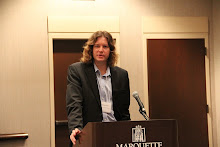
In my spare time, when not reading academically motivated texts, I am currently reading Chalmers Johnson's book Nemesis: The Last Days of the American Republic. So far it is an exceptional, if rather depressing and disturbing, book. In the course of reading it I came upon a quotation from Hannah Arendt discussing Eichmann and the banality of evil which I thought I would share:
Showing posts with label quotations. Show all posts
Showing posts with label quotations. Show all posts
Monday, November 22, 2010


Saturday, September 4, 2010
Quotation for the Day
Hegel on philosophizing in natural language:
"But that which is in itself must just not have this foreignness for us, and we must not give it this foreign look by using a foreign terminology, but must count ourselves really convinced that the spirit itself is alive everywhere and that it expresses its forms in our own spontaneous natural language."
From Rosenkranz's Das Leben Hegels
Thursday, September 2, 2010
Quotation for the Day
I have been brushing up on some Dilthey in preparation for my paper presentation at this years meeting of S.P.E.P., so I figured I would throw out a Dilthey quotation in honor of this lovely Thursday afternoon:
"The individual always experiences, thinks, and acts in a sphere of commonality, and only in such a sphere does he understand. Everything that has been understood carries, as it were, the mark of familiarity derived from such common features. We live in this atmosphere; it surrounds us constantly; we are immersed in it."
The Formation of the Historical World in the Human Sciences p. 168
Saturday, July 24, 2010
Quotation for the Day
"I harbor for good or bad, I permit to speak at every hazard,
Nature without check with original energy."
Walt Whitman
Nature without check with original energy."
Walt Whitman
Saturday, June 12, 2010
Rilke on the Unsayable and Sayable
From the tenth of the Duino Elegies as translated by David Young:
"Ah, but what can we take across to the other realm when we leave?
Not our perception learned here so slowly and nothing
that's happened here. Not one thing. So that means we take pain.
Take, above all the heaviness of existing, take the long
experience of love, take truly unsayable things.
But later under the stars why bother?
They are better at the unsayable. After all, isn't what
the wanderer brings back from the mountain slopes to the valley
not a handful of earth that no one could say but rather a word
hard-won, pure, the yellow and blue gentian?
Are we on this earth to say: House, Bridge,
Fountain, Jug, Gate, Fruit-tree, Window -
at best: Column... Tower...?
but to say these words you understand with an intensity
the things themselves never dreamed they'd express. Isn't the earth's
hidden strategy when she so slyly urges two lovers on
that each and everything should be transformed by the delight
of sharing their feelings? Threshold:
what it means to two lovers that they too
should be wearing down an old doorsill a bit more
after the many before them and before
the many to come ... lightly.
Here is the time for the sayable, here is its home.
Speak, bear witness. More than ever things fall away from us
livable things and what crowds them out and replaces them
is an event for which there's no image. An event
under crusts that will tear open easily
just as soon as it outgrows them and its interests
call for new limits. Between the hammer strokes our hearts survive
like the tongue that between the teeth and in spite of everything
goes on praising.
Praise the world to the angel, not the unsayable,
you can't impress him with sumptuous feelings - in the universe
where he feels things so fully you're just a novice.
Show him, then, some simple thing shaped by its passage
through generations that lives as a belonging near the hand, in the gaze."
Tuesday, May 25, 2010
"Quotation for the Day" or "A Thought about Thought"
My recent discussions of Meillassoux and Thought-World-Correlationism has given rise to some discussion about the thinkable, unthinkable, meaningless and so on. I think these are very interesting questions, but in general I find the conception of "thought" which philosophy has tended to work with to be a fairly deceptive theoretical distortion. In this I follow Heidegger. If we look to how we make our way through the world on a day to day basis we find something rather different than the "thought" we find discussed in many areas of philosophy.
Here is a Wittgenstein quotation on the subject which may serve to change some of the recent tone of my blog. It is from his Remarks on the Foundations of Mathematics and calls into question which it means for thought or inference to be constrained. We might take it to be a comment on what we mean by the thinkable and unthinkable:
"And thinking and inferring (like counting) is of course bounded for us, not by an arbitrary definition, but by natural limits corresponding to the body of what can be called the role of thinking and inferring in our life... And I say further that the line between what we include in 'thinking' and what we no longer include in 'thinking' is no more a hard and fast one than the line between what is still and what is no longer called 'regularity'. Nevertheless the laws of inference can be said to compel us; in the same sense, that is to say, as other laws in human society."
Sunday, May 9, 2010
Quotation for the Day
"We must convert facticity into the real property whereby everything and every world is without reason. We must grasp how the ultimate absence of reason, which we will refer to as 'unreason', is an absolute ontological property, and not the mark of the finitude of our knowledge."
Meillassoux again. That is quite a task! I am still trying to decide what I think of his attempt and his reading of Heidegger. I will post more of a discussion soon. Also some comments about this years meeting of the Heidegger Circle will appear soon.
Meillassoux again. That is quite a task! I am still trying to decide what I think of his attempt and his reading of Heidegger. I will post more of a discussion soon. Also some comments about this years meeting of the Heidegger Circle will appear soon.
Friday, April 30, 2010
Quotation for the Day
Here is a quotation from Quentin Meillassoux' After Finitude:
"For it could be that contemporary philosophers have lost the great outdoors, the absolute outside of pre-critical thinkers: that outside which was not relative to us, and which was given as indifferent to its own givenness to be what it is, existing in itself regardless of whether we are thinking of it or not; that outside which thought could explore with the legitimate feeling of being on foreign territory - of being entirely elsewhere."
"For it could be that contemporary philosophers have lost the great outdoors, the absolute outside of pre-critical thinkers: that outside which was not relative to us, and which was given as indifferent to its own givenness to be what it is, existing in itself regardless of whether we are thinking of it or not; that outside which thought could explore with the legitimate feeling of being on foreign territory - of being entirely elsewhere."
Monday, April 19, 2010
Quotation for the Day
Here is a quotation from Wittgenstein's Remarks on the Foundations of Mathematics which presents a nice picture of nominalism.
"...[Practice] surrounded the word with a whole lot of pictures (visual and others) of which one or another comes up when we hear and speak the word. (And if we are supposed to give an account of what the 'meaning' of the word is, we first pull out one from this mass of pictures - and then reject it again as non-essential when we see that now this, now that, picture presents itself, and sometimes none at all.)"
I am becoming more and more interested in nominalism recently, and have faced some interesting resistance when arguing against some of Husserl's claims from a nominalist position. I think in the near future I will be revisiting Berkley and Spinoza, and perhaps even wading into the medievals, in order to focus in on this issue. Specifically I am interested in what nominalism looks like when its mentalistic elements are taken away. Imagine a nominalism embodied in lived practice without mental images or pictures. I feel that some of my interpretations of Heidegger's work push in this direction. Both Wittgenstein and Althusser are also helpful on this point.
Saturday, April 17, 2010
Quotation for the Day
This is from Beckett's "Ohio Impromptu":
"Could he not now turn back? Acknowledge his error and return to where they were once so long alone together. Alone together so much shared. No. What he had done alone could not be undone. Nothing he had ever done alone could ever be undone. By him alone."
"Could he not now turn back? Acknowledge his error and return to where they were once so long alone together. Alone together so much shared. No. What he had done alone could not be undone. Nothing he had ever done alone could ever be undone. By him alone."
Monday, April 12, 2010
Quotation for the Day
I am a big fan of sharing striking quotations I come across in my reading. They tend to be drawn from a wide spectrum of sources. I wont agree with them all, but I find each interesting.
Quotation of the Day from Melville's Moby-Dick:
"Glimpses do ye seem to see of that mortally intolerable truth; that all deep, earnest thinking is but the intrepid effort of the soul to keep the open independence of her sea; while the wildest winds of heaven and earth conspire to cast her on the treacherous, slavish shore?"
This is such a nice reversal of the island imagery we find in Rousseau and Kant. Here is a bit of Kant:
"We have now not only traveled through the land of pure understanding, and carefully inspected each part of it, but we have also surveyed it, and determined the place for each thing in it. This land, however, is an island, and enclosed in unalterable boundaries by nature itself. It is the land of truth (a charming name), surrounded by a broad and stormy ocean, the true seat of illusion, where many a fog bank and rapidly melting iceberg pretend to be new lands and, ceaselessly deceiving with empty hopes the voyager looking around for new discoveries, entwine him in adventures from which he can never escape and yet also never bring to an end."
Subscribe to:
Posts (Atom)